Selected MP3s of guitar instrumentals, jazz, big band, and classic easy listening from the original vinyl.
Welcome to Guitars & All That Jazz
Welcome to Guitars & All That Jazz
Guitars & All That Jazz was a radio station that webcast via Live365 for 11 years, ending in June 2011. The playlist consisted of guitar instrumentals, jazz, big band, early rock 'n' roll, lounge music and classic easy listening.
I hope to share some of this music with you via this blog. Most of it will be taken from the original vinyl (LPs and 45s) , cassettes and the occasional commercially unavailable CD.
Here's hoping you'll find something to enjoy. Please note files are available only for a limited time.
I urge you to purchase the digital version of the albums featured, either on CD or via download, wherever possible.
Listen to the Music
There are now two music streams. Click the appropriate player to the right.
1. Guitars & All That Jazz:Five hours of the best in jazz, guitars and other instrumental gems. New songs are added weekly.
2. Tiki Shores: Music to sweep you away to a tropical isle, a South American dance floor or a bossa nova on the beach at Rio. About 4.5 hours of classic exotica music, Latin rhythms and bossa nova.
Macy's, a rockin' sax-organ combo piece by the Jack Cole Quintet, sounds very much like Plas Johnson's singles for Capitol in the 1950s. You can also hear the influence of Earl Bostic's fine sides for King.
It's not surprising that Cole (I'm assuming he's the sax player) sounds very much like Johnson. On the "A" side of this single is a cover of Sax Fifth Avenue, which Johnson took into the charts, using the pseudonym Johnny Beecher, in the spring of 1963. Both versions were released around the same time.
Sax Fifth Avenue and Macy's appear to have been the only two sides recorded by the Jack Cole Quintet. Macy's
Neither side of this single has appeared in a digital format.
Trumpeter Billy Martin was from New York, but he and his fine funk band the Soul Jets did most of their recording in Montreal, Quebec.
Martin played in New York and Europe and studied at conservatories in Manhattan and Frankfurt, Germany. In the late 1960s he and his group toured Eastern Canada, staying in Montreal for a while. While there they recorded at least two albums -- Doin' Their Thing (London, 1969) and Strawberry Soul (Trans-World, 1970). Both were released only in Canada, are hard to find and have not been released digitally.
There was a third Billy Martin album of uncertain origin, I Turn You On, released on the Onion label in 1974. It possibly was made during the same period as the Canadian LPs. However, unlike those two releases it's a mainly vocal affair.
On the strictly instrumental Doin' Their Thing Billy Martin and the Soul Jets are in great form throughout, as evidenced by The Strut.
The Strut
Billy Martin seemed to disappear from the music scene after making the records in Canada. It doesn't appear that there were any further recordings with the exception of I Turn You On, which may or may not have been done later. Here's a sample from that LP.
Not a surf record as you might expect from the group's name but a tasty slice of Detroit instrumental soul from 1966.
Very little is known about the group, which recorded a half dozen or so singles for at least four labels. Credits on the record labels indicate the involvement of Buffalo, N.Y., DJ and record man Tom Shannon and Carl Cisco, who had both relocated to Detroit and were associated with another Swan recording group, the Rockin' Rebels (Wild Weekend). For further information (and some well-informed speculation) on the Buena Vistas read this post on the excellent Funky 16 Corners blog.
Hot Shot came out in May 1966 and was a minor hit on both the Billboard (#87) and Cashbox (#82) charts.
Hot Shot
The flip side of the single was T.N.T., an organ driven number that reminds me somewhat of Dave (Baby) Cortez (The Happy Organ, Rinky-Dink).
Both sides of this single are being peddled as downloads from all the major sources, but I'd be willing to bet they've been dubbed from vinyl.
Hot Shot is also included on the 1996 CD compilation Swan's Soul Sides: Dance the Philly from the highly-regarded Ace label in the U.K. It's available at a reasonable price from Amazon and other online sellers.
Jazz and R&B guitarist Wilbert Longmire gained a bit of notice after he joined pianist Bob James's Tappan Zee label in 1978. Longmire and George Benson knew each other and it was Benson who brought him to the attention of James.
Longmire's third Tappan Zee release, With All My Love (1980), contained the radio friendly track Hawkeye, which scored some airplay.
Longmire had begun his recording career as a solo artist in 1969 with the LP Revolution for World Pacific, and the LP pictured above also predates Longmire's Tappan Zee signing. The Way We Were (1975) came out on Astra Records, but the minimal packaging and black-and-white cover indicate this was probably a private release.
Longmire is joined on The Way We Were by keyboardist Bill Mason, Billy Kaye, percussion, bassists Lee Tucker and Robert Evans, drummer Larry Langston and rhythm guitarist Mark Shulte. Longmire's playing on the title track reminds us just how beautiful this tune is.
The Way We Were
The Way We Were has never had a digital release and vinyl copies go for $40 and up on the collectors' market. However, two of Longmire's Tappen Zee albums, Champagne and With All My Love, have appeared on an import CD that's available from Amazon and other online sellers.
Longmire apparently has not recorded as a leader since his Tappen Zee days. As of 2011 he was living in the Cincinnati area and playing local gigs.
Here's the track that got Longmire some national attention in 1980.
The 1960s certainly proved to be a hotbed of dance crazes. The twist, the watusi, the monkey, mashed potato -- the list goes on and on.
Dance records seemed always to be on the charts, thanks in large part to powerful AM radio stations that covered much of the U.S. and network T.V. dance shows like American Bandstand. The countless local dance shows and promotions also played a significant role.
The success in 1968 of the dance instrumental The Horse by Cliff Nobles & Co., a No. 2 pop hit, inspired a raft of horse-themed singles, most of which passed unnoticed at the time and have now been largely forgotten.
Many of these records, like Cliff Nobles's original, emanated from soul labels in Philadelphia. Still others popped up from recording studios elsewhere.
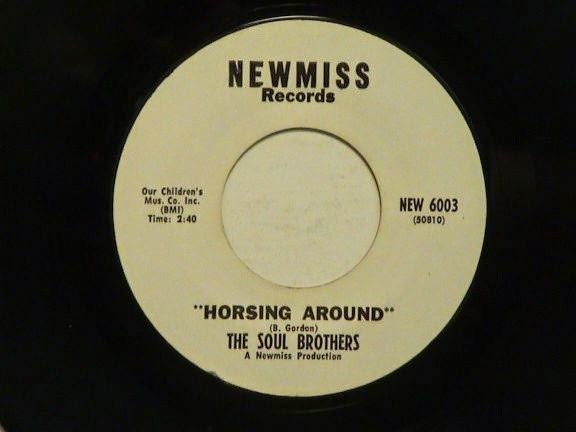
Horsing Around by the Soul Brothers, led by Benny Gordon, came out of New York City sometime in '68. Although the group hailed from South Carolina most of their sessions took place in New York.
What sets Horsing Around apart from the other horse records is the dynamic drumming and the really tight horn section.
Horsing Around
Horsing Around was among the 21 tracks gathered in 2011 for the excellent northern soul CD compilation Dynamic Grooves: Funk and Groovy Soul from the Vaults of Scepter, Wand, Dynamo and Musicor. It's on the BGP (Beat Goes Public) label, an imprint of Ace Records in the U.K., and is widely available from Amazon and elsewhere at a reasonable price.
And here's The Horse that started it all, from Cliff Nobles & Co.
Although the background of saxophonist Sil Austin (1929-2001) was in jazz he enjoyed most of his success in the R&B and pop fields. His big breaks came in the jazz bands of Roy Eldridge and Cootie Williams. In 1953 Austin moved into R&B when he joined Tiny Bradshaw's band.
The saxophonist signed with Mercury Records in 1956 just as rock 'n' roll was hitting its stride and enjoyed a Top 20 record with Slow Walk. It was to be his only significant pop hit, although he continued to record for Mercury for the next 12 years. Some of Austin's LPs sold well, with the most popular proving to be Sil Austin Plays Pretty for the People (1959), where he was backed by a string orchestra.
He made some easy listening albums for SSS International in Nashville in the late 1960s and early '70s, but there was only the odd recording session after that.
(For a first-rate personal reminiscence about Sil Austin go to The Funk Show website.)
Among the many Mercury singles that followed the success of Slow Walk was Hey! Eula (flip side: Rainstorm), which came out in 1958. This stompin' piece of R&B sax and guitar has a rather odd source. The tune was written by Alex North for the soundtrack of The Long Hot Summer, the 1958 Martin Ritt film that starred Paul Newman, Orson Welles and Joanne Woodward. The version on the soundtrack, played by the 20th Century Fox Orchestra, is much more jazzy. Below are both recordings.
Hey! Eula (Sil Austin)
Hey! Eula (soundtrack)
None of Sil Austin's fine recordings for Mercury seem to be available on CD at a reasonable price. All that's on offer are several expensive imports. Best bet to sample some of his Mercury tracks is the download version of the compilation Swingsation, available from Amazon and elsewhere.
The CD compilations Great Sax and Sentimental Sax provide a sampling of his later recordings for SSS, but there is some duplication of tracks. Used copies are reasonably priced.
Birthday Party, which made the R&B chart in 1957, was the followup to Austin's hit Slow Walk.
Pianist and organist Floyd Morris (d. 1988, age 62) spent most of his time enlivening rhythm-and-blues recording sessions in his native Chicago and had a very limited career as a solo artist, waxing half a dozen singles and the album The ConSoul of Floyd Morris (Select, 1965) between 1964 and 1972.
In the early '50s Morris appeared with a group known as the Four Shades of Rhythm at the Bar-O-Music in Chicago for several years but apparently did not record with them. He moved on to join bassist Johnny Pate's trio and then vocalist Oscar Brown, Jr. Morris settled in at Chicago's studios backing artists like Gene Chandler, The Impressions and Etta James.
That brings us to The ConSoul of Floyd Morris, a fine helping of organ instrumental R&B that also features the sax of Buddy Lucas, another veteran of the studio scene. Lucas had played on hits such Why Do Fools Fall in Love by The Teenagers and Tears on My Pillow by Little Anthony and the Imperials.
Here's a sample track from the LP, which has not been re-released in a digital format.
Call Me Darling
One of Floyd Morris's most notable appearances isn't that well known. He plays piano on Soulful Strut, which was a big instrumental hit in 1968. The record was credited to Young-Holt Unlimited, formed by two former members of the Ramsey Lewis Trio, bassist Eldee Young and drummer Red Holt. The tune had begun life as a backing track for singer Barbara Acklin's Am I the Same Girl. The vocal was stripped out and Morris's piano was added and the result was Soulful Strut, which sold two million copies.
According to Robert Pruter's book Chicago Soul neither Young nor Holt appeared on Soulful Strut, which was tracked by an anonymous group of studio players. In any case, here it is.
Johnny Beecher was a pseudonym that tenor saxophonist Plas Johnson used to record two albums for the Charter label in 1963. Johnson was under contract to Capitol at the time.
The title single of the first LP, Sax Fifth Ave., was a minor hit, garnering a fair amount of airplay. It originally came out on the Hollywood-based Omega label before Warner Brothers picked it up for national distribution. I believe Omega and Charter were part of the same company, but for some reason the Charter LPs were distributed in the U.S. by MGM.
The Sax Fifth Ave. single had a "B" side, Jack Sax the City, that didn't appear on either of the albums. Perhaps this stomping piece of crime jazz didn't fit the more laid back vibe of the long-players.
Jack Sax the City
The personnel on the Sax Fifth Ave. LP included organist Bert Kendrix (misspelled as Kendricks on the single but spelled correctly on the LP), Emil Richards on vibes, bassist Jimmy Bond and either Earl Palmer or Wayne Robinson on drums. All were veterans of Los Angeles recording studios.
Both Charter LPs -- the second was On the Scene -- were combined on a 2004 CD from Blue Moon Jazz, an imprint of the Spain-based Fresh Sound Records, and issued under Mr. Beecher's real name. The Warm Sound of Plas Johnson, Tenor Sax, Vol. 1: Midnight Blues can be ordered direct from the company. The single's "B" side, available above, is not on the CD.
Here's the one Johnny Beecher hit. The label shown is the original release before Warner Brothers picked it up.
The career of bandleader Tiny Bradshaw (1905-1958) spanned both the swing and rhythm-and-blues eras. He made his first recordings under his own name for Decca in 1934.
Bradshaw struggled over the next decade or so and when he got his band into the recording studio again, in 1944, he'd more or less left swing behind, opting for jump blues and R&B.
All of Bradshaw's best known R&B sides were cut for King Records in Cincinnati, with the majority coming between 1950 and 1954.
The instrumental Heavy Juice came out in 1953 and was reasonably successful as a followup to Bradshaw's big hit of 1952, Soft. Saxophonist Red Prysock is listed as co-writer of Heavy Juice and since he was a member of Bradshaw's band around this time, I'm assuming it's him playing the brief, but rousing, sax solo.
Heavy Juice
Most of the sides that Bradshaw recorded for King are available on Heavy Juice: The King Recordings 1950-55, a 32-track CD compilation issued by Rev-Ola in 2006.
The CD is out of print, but copies appear to be still available from the long-established and reliable Raucous Records, based in the United Kingdom. Postage rates for international customers are reasonable and the price ends up being half of what most North American sources are charging.
This 1967 single has saxophonist King Curtis recording under the name of his band, the Kingpins. In the Pocket is the "B" side of yet another cover of Ode to Billie Joe, which actually was a moderate hit for Curtis under the Kingpins name. Apparently some pressings of the single give Curtis top billing, probably after Ode to Billie Joe got a fair amount of airplay.
In the Pocket was one of the few originals recorded at a session on Aug. 24, 1967, at American Studios in Memphis. It's a real "B" side gem. Listen to the MP3 taken from the original Atco single.
In the Pocket
In the Pocket has turned up on several King Curtis compilations and re-releases in the digital age, both on CD and as a download. On CD the one to go for is Instant Soul: The Legendary King Curtis from the well-regarded Razor & Tie label. You can get a used copy on Amazon for about $11.
It's not surprising that this single from Detroit drummer Paul Humphrey has one foot in the disco camp, since it's from the soundtrack of a 1974 blaxploitation flick, Black Fist, in which star Richard Lawson plays a streetfighter who goes to work for a gangster.
Philip Michael Thomas (Miami Vice) and Dabney Coleman are the most recognizable names in the cast, which also includes Edward James Olmos making his screen debut.
Although the film came out in '74 the soundtrack album, featuring disco and funk tracks from various artists, wasn't released until 1977.
Paul Humphrey's contribution was also released as a single (b/w Bionic Salsa).
Humphrey's Overture
Neither the Black Fist soundtrack nor any of Paul Humphrey's recordings, including his 1971 hit Cool Aid (credited to Paul Humphrey and the Cool Aid Chemists), are available as downloads, despite what iTunes may think. That site has managed to confuse the drummer with a Toronto-based singer of the same name. The Paul Humphrey and Cool Aid Chemists album (1971) is available on a Japanese CD, but prices start at about $30.
Billy Ward and the Dominoes were one of the most successful R&B groups of the early 1950s, but by the time this LP came out in '57 they were starting on their way down.
Many people assumed at the time that Ward was the lead singer, but that wasn't the case. Although Ward was the group's musical director (and by all accounts a strict disciplinarian) and played piano, the Dominoes' success was based largely on the styles of lead tenors Clyde McPhatter (1950-53) and Jackie Wilson (1953-57). When McPhatter departed to form The Drifters, Wilson was his replacement.
The group's success was largely confined to the R&B chart and the Dominoes had not had a pop hit since Sixty-Minute Man in 1951. That changed in 1956, a year after Ward signed the group with Decca, when St. Therese of the Roses was a surprise chart entry. It was included on the Billy Ward and the Dominoes album, which also included a version of To Each His Own, a 1946 composition by Jay Livingston and Ray Evans. Eddy Howard, Freddy Martin and His Orchestra, the Ink Spots and several others recorded hit versions at the time. On the Dominoes' recording Jackie Wilson is the lead singer.
The MP3 is from the original vinyl LP.
To Each His Own
Some of the Dominoes Decca recordings, including St. Therese of the Roses and To Each His Own, are available almost everywhere on various download compilations, many of them of dubious origin. The quality varies widely.
The best overview of the group's career on CD, although it only includes a couple of Decca cuts, is Sixty-Minute Men: The Best of Billy Ward & His Dominoes, a 1993 compilation from Rhino.
Hank Jacobs made some pretty interesting organ and piano instrumental sides, mainly for Sue Records, in the 1960s. Jacobs managed only one chart single under his own name, So Far Away (b/w Monkey Hips and Rice), which was a minor hit in early 1964.
Subsequent singles on Sue followed a similar style, one that might best be described as subdued funk. Heide (b/w Playboy's Penthouse) was issued later in '64.
Heide
Many of his Sue singles, including both sides of the So Far Away and Heide 45s, were on a So Far Away LP issued in late '64.
Jacobs later played with a studio band called the T-K-O's, who scored an R&B hit in 1966 with The Fat Man on the Ten-Star label. The following year he backed singer Bettye Swann on her chart-topping R&B hit Make Me Yours.
Only three or four of Jacobs's tracks are available on various compilations from iTunes and other download sources. His hit So Far Away has also turned up on several CD collections. Other than that he's not represented in the digital format.
Saxophonist Tommy Wills had been recording in the Cincinnati area as far back as 1955. Think Ace Cannon and Boots Randolph and you'll have a pretty good idea of Wills's sound.
Wills always recorded on his own labels, beginning with Club Miami (the night spot in Hamilton, Ohio, where the sax man first gained notice), Big Bang and Terry in the 1950s. The records themselves were pressed by other companies, usually in Cincinnati. In the '60s and '70s Wills formed at least five other labels, including Airtown, which started around 1965 in Dayton, Ohio, and later moved to Richmond, Ind., still within easy driving distance of Cincinnati.
Funky Sax, a Wills original, graced the "B" side of a single that came out in 1967 or '68. The "A" side, billed as a tribute to Ray Charles, was a medley of Born to Lose and I Can't Stop Loving You, two songs that were on Charles's groundbreaking 1962 album Modern Sounds in Country and Western Music.
For my money, however, Funky Sax is the tune to listen to.
Funky Sax
As late as 2010 Wills -- who was well into his 80s -- was still performing the occasional gig in the Indianapolis area.
Here's a sampling of the ballad style of Tommy Wills. I'm not certain of the date of this recording.
This 45 was issued by Blue Note in 1968 to promote Hank Mobley's LP Reach Out. The album was the bop saxophonist's not altogether successful attempt to court a wider audience by covering a couple of R&B and pop tunes.
The LP took its name from a cover of the Four Tops hit Reach Out, I'll Be There, which was the "A" side of the Goin' Out of My Head single.
The two tracks on the single have been drastically shortened from the album cuts, so if jazz takes on R&B hits are your thing, buy the album, which is easily obtainable either on CD or via download. In the meantime, here's the shortened 45 version of Goin' Out of My Head.
Goin' Out of My Head
Although Reach Out was somewhat of a misfire musically, it's not the disaster painted by many jazz critics and others who view themselves as jazz purists. They would do well to remember that jazz was once popular music and to have a musician such as Mobley attempt to regain the genre's wider audience is no sin.
Finally, here's the full LP version of Reach Out, I'll Be There.
By the time this album came out on Mega Records in 1971 all the core members of the Bill Black's Combo that scored a number of instrumental hits in the 1960s were long gone. In fact leader Black had died of a brain tumor in 1965, at age 39.
Black, of course, was the bass player on all the early Elvis Presley recordings for Sun and the first sides that Elvis recorded for RCA Victor.
Black formed his own combo in 1959 and scored a number of instrumental hits, among them Smokie, Part 2, White Silver Sands and Don't Be Cruel.
The band heard on The Memphis Scene is under the direction of producer Larry Rogers, who had opened a Memphis recording studio, Lyn Lou Studio, with Black in 1962. Saxophonist Robert Gladney is the only musician identified on the album, although road manager and bassist Bob Tucker, who joined the combo in 1963 and had taken over leadership of the group after Black's death, likely also was part of this recording.
The Memphis Scene retains the basic sound of the classic Bill Black's Combo of the '60s, but adds a few funk elements as well.
Memphis Shuffle
The Memphis Scene is not available in a digital format.
Here's another selection, a funky little thing called Cotton Carnival, that was included on the LP.
I always tend to cast a jaundiced eye towards albums in which a pop or R&B/soul star decides to redo some prime selections from the standards songbook. The misfires far outnumber the successes, often because the artist has little or no affinity for the material.
Happily, The Other Side of the Moments (1972, Stang) is one of those that does succeed, due to a combination of the group's genuine feel for the songs and the out-of-the-park arrangements by Sammy Lowe.
Lowe's roots lie in the big band era, during which he played with and arranged for the Erskine Hawkins orchestra. He would go on to arrange and conduct on one of James Brown's biggest hits, It's a Man's, Man's, Man's World (1966), and dozens of other chart singles and LPs by the likes of Nina Simone, Sam Cooke, The Tokens and Della Reese.
In 1972 came Lowe's work on The Other Side of the Moments, a New Jersey soul group who topped the R&B charts twice in the 1970s, with Love on a Two-Way Street (1970) and Look at Me (I'm in Love) (1975).
Included on the LP was Lowe's most unusual arrangement of Blues in the Night, composed in 1941 by Harold Arlen and Johnny Mercer. The MP3 is sourced from the original LP. Blues in the Night
The Other Side of the Moments can be had as a download from iTunes and other sources. The album has received two releases on CD, the easiest of which to obtain is a 2006 release from the Collectables label that pairs it with another Moments release, My Thing. Reasonably priced copies are available in the Amazon Marketplace.
You're probably looking at this and thinking ... Hmmm ... Is this something I really want to hear?
Don't be put off by the geeky looking cover or the wimpy title. Inside is a wonderful LP of down-to-earth organ and sax R&B grooves courtesy of Merlin and His Trio, whoever they might have been. I believe this came out in 1959 or 1960 and was probably recorded several years earlier.
Think Wild Bill Davis or Bill Doggett and you'll have a pretty good idea of what you'll hear. To whet your appetite check out the sample track.
Bluer Than Blue
The Swinging Hi-Fi Organ was issued on the bargain basement Bravo! label, put out by Pickwick Sales, a company that was originally headquartered in Freeport, Long Island, N.Y. Many of the Bravo releases -- there were about 60 of them -- were reissued several years later on Grand Prix, another Pickwick imprint, with the same catalogue numbers and identical front covers. Some of these albums, on both labels, were in mono only.
The Swinging Hi-Fi Organ still turns up in thrift stores, so grab it if you see it. However, there are several other LPs sporting the Merlin name that, unless you're a fan of roller-rink style organ music, you can safely ignore.
The tenor saxophone of Rusty Bryant (1929-1991) graced some fine soul-jazz albums for Prestige in the late 1960s and early '70s. He'd come up through the rhythm-and-blues ranks in the '50s, recording several sessions that were issued on Dot. Among the tunes recorded was a frantic version of Night Train that was re-titled All Nite Long and became something of a jukebox hit.
But ... back to those Prestige recordings. Fire Eater was the title tune of a 1971 album that included Wilbert Longmire on guitar, Leon Spencer and Bill Mason alternating on organ and Idris Muhammad on drums.
For jazz DJs Prestige issued a single, Fire Eater/The Hooker, with severely truncated versions of those album tracks -- three minutes as opposed to about nine minutes on the LP. Here's the Fire Eater single. Mason is the organist on this track.
Fire Eater
Fire Eater and another Rusty Bryant album from 1971, Wildfire, were combined on a 1991 Prestige CD, Legends of Acid Jazz, Vol. 2. You'll have no trouble scoring a copy of this as cheap copies (some for less than $5) abound online.
From YouTube here's a sample of Bryant's hard driving R&B style from 1956.
Like many of the Hammond organ players in jazz Milt Buckner (1915-1977) began as a pianist. His penchant for rocking rhythms and boogie woogie served him well when he began using the organ in the 1950s.
Buckner, if one discounts the early pipe organ recordings of Fats Waller and the occasional forays on the organ by Count Basie, was a pioneer, along with Wild Bill Davis, in the use of the instrument in jazz. His influence extended into both jazz and rhythm-and-blues and helped pave the way for the likes of Bill Doggett, Jimmy Smith, Jack McDuff and countless others.
Buckner recorded prolifically for Capitol, Argo, Bethlehem and Cadet in the '50s and '60s. You'll get your money's worth with any of these recordings. In my opinion Buckner never made a bad album -- and I've heard most of them.
After 1966 Buckner lived almost exclusively in Europe. He recorded a series of high-quality albums in France for the Black & Blue label.
The Bethlehem 45 of Fever (b/w Why Don't You Do Right) dates from 1963. Both sides of the single were included on the LP The New World of Milt Buckner.
Buckner is accompanied by Gene Redd on vibes, Bill Wallis on bass and Phil Paul on drums. You can listen to Fever (MP3 taken from the 45 single) below.
Fever
The New World of Milt Buckner apparently was issued on a Japanese CD earlier this year, but it doesn't appear to be available anywhere outside of Japan. The album, however, is easily obtained as a download from a variety of sources.
From YouTube here's the extended album version of Fever. It's a minute or so longer than the 45 edit -- in stereo, too.