Listen To:


Selected MP3s of guitar instrumentals, jazz, big band, and classic easy listening from the original vinyl.

Welcome to Guitars & All That Jazz

Welcome to Guitars & All That Jazz

Guitars & All That Jazz was a radio station that webcast via Live365 for 11 years, ending in June 2011. The playlist consisted of guitar instrumentals, jazz, big band, early rock 'n' roll, lounge music and classic easy listening.

I hope to share some of this music with you via this blog. Most of it will be taken from the original vinyl (LPs and 45s) , cassettes and the occasional commercially unavailable CD.

Here's hoping you'll find something to enjoy. Please note files are available only for a limited time.

I urge you to purchase the digital version of the albums featured, either on CD or via download, wherever possible.

Listen to the Music
There are now two music streams. Click the appropriate player to the right.
1. Guitars & All That Jazz: Five hours of the best in jazz, guitars and other instrumental gems. New songs are added weekly.
2. Tiki Shores: Music to sweep you away to a tropical isle, a South American dance floor or a bossa nova on the beach at Rio. About 4.5 hours of classic exotica music, Latin rhythms and bossa nova.
Powered By Blogger
Showing posts with label Latin. Show all posts

Tuesday, August 12, 2014

Pepe Jaramillo - Mexican Mirage

                                          (Photo from Audio Design Studio blog)

What little information there is on Mexican-born pianist Pepe Jaramillo has to be gleaned form the less than reliable information contained in LP liner notes. There are almost no biographical details available online.

According to the album information Jaramillo was born in the northern Mexican state of Chihuahua. Sometime in the 1940s he began playing at the Ritz Bar in Mexico City, later moving to the newly-opened The Quid. His fame grew and he began appearing on radio and TV.

A visit to France in 1957 led Jaramillo to move to Europe. After some TV work for the BBC he went to live in London.

Jaramillo had a long career in Britain, recording prolifically for various EMI labels from 1959 through the 1970s. Many of his easy listening Latin-flavoured albums were recorded for the company's high end Studio 2 Stereo imprint, including Mexican Mirage (1973). A sample track is below.

Can't Take My Eyes Off You


Very few of Jaramillo's albums have been released on CD and the only one currently in print is a compilation from the Jasmine label, Salud Pepe. You'll have no trouble picking up a copy at a reasonable price.

There's a variety of Pepe Jaramillo downloads to peruse. Quality is likely to vary widely, so choose carefully.

Here's another track from Mexican Mirage.

Saturday, June 14, 2014

Various Artists - South of the Border (Reader's Digest box)


The supply of LP box sets put out by Reader's Digest in the 1960s and '70s seems endless. Most of these can be bought for peanuts at garage sales and thrift stores, so you can safely ignore the mostly ridiculous prices being demanded online.

These recordings may be cheap to obtain, but don't make the mistake of thinking they are substandard in quality. For the most part the Reader's Digest boxes are excellent technically. Musically most of them tend to stick to easy listening and background music, with occasional forays into light classical and jazz. Many of the tracks were repackaged, often several times, in different box sets. This continued into the CD era.

Like many of the sets South of the Border (1968) mines the vaults of RCA Victor. The majority of the tracks on the four LPs were recorded by RCA in Mexico and their release by Reader's Digest was their first appearance in the U.S., Canada and the U.K.

Among the Mexico-recorded tunes is Cachita by Tonio Rivera and His Orchestra. This name does not seem to exist outside the Reader's Digest releases and is likely a moniker assigned to a studio group.

Cachita


Since the music on Reader's Digest box sets has been endlessly repackaged, both on LP and CD, it's difficult to tell what, if anything, is available from South of the Border. Best bet, as I said at the start, is to watch the garage sales and thrift stores for the vinyl.

One of the most common Reader's Digest boxes is Mood Music for Listening and Relaxation (1963). This must have been a pretty big seller, judging from the number of copies still around. Here's a sample track, which was likely recorded in England.


Saturday, April 19, 2014

Al Caiola - Percussion Espanol


Two volumes of Percussion Espanol by guitarist Al Caiola were issued in 1960 by Time Records, whose early releases were designed to showcase the emerging medium of stereo. This was most often accomplished by the generous (and sometimes excessive) use of percussion that often "ping-ponged" between the left and right channels.

As one of the early issuers of genuine stereophonic LPs, Time competed with labels like Audio Fidelity and producer Enoch Light's Command Records.

The two Percussion Espanol albums (Vol. 1 is shown above) came out around the time that Caiola was enjoying chart success with the western themes Bonanza and The Magnificent Seven, both of which were recorded for United Artists. The guitarist stayed with that label until the end of the 1960s.

Percussion Espanol contains some pretty decent Latin big band arrangements by Caiola, who orchestrated the tunes recorded at sessions in New York on May 16 and 17, 1960. Most of the tunes are extremely short, however, no doubt in an effort to encourage airplay. Tico, Tico, for instance, runs just 1:50.

The MP3 is from the vinyl LP.

Tico, Tico


Neither of the Percussion Espanol albums has been issued on CD, but both volumes are available as downloads from most of the major sources. These are being marketed by a rejuvenated Time Records label and are very good quality for a compressed file.

Another sample from the first volume is below.


Friday, March 28, 2014

The Johnny Williams Orchestra Plays Sounds from Screen Spectaculars


The Johnny Williams Orchestra Plays Sounds from Screen Spectaculars (Craftsmen, 1957) spotlighted future composer and conductor John Williams at the beginning of his career as a pianist and studio musician.

This was long before Williams gained wide fame for his scores for such movie blockbusters as Jaws and Star Wars, and for conducting the Boston Pops Orchestra.

This budget label LP does not appear to have sold very well and within a year it was reissued with a new title, Big Hits from Columbia Pictures, and a far more sales worthy cover featuring cheesecake portraits of Kim Novak and Rita Hayworth.


This version came out on no less than three different labels -- Tops, Golden Tone and Mayfair -- in 1958. All the labels were owned by the same company, with the Golden Tone and Mayfair releases including stereo versions of the LP.

Note that the album is now credited to the Hollywood Grand Studio Orchestra conducted by John T. Williams.

The Latin standard Brazil was among the tracks on the LP due to its inclusion in the film The Eddy Duchin Story, which came out in 1956. The orchestra sits out for this tune: It's just Williams on piano with a small combo.

Brazil


This early album by John Williams gained new life in the digital age when it was released on a Pickwick CD in 1996.


Movie Memories was mastered from the original stereo tapes and the sound quality is excellent. The CD is out of print but there are plenty of cheap copies for sale online. The album is also available as a download.

Sunday, March 16, 2014

Django Reinhardt - Brazil (1947 version)


An encyclopedia of biographical and discographical information on Belgian-born French guitarist Django Reinhardt (1910-1953) is available in print and online, so I'm not going to repeat much of it here. Suffice it to say that Reinhardt is generally regarded as one of the greatest guitarists in jazz history and was among the first European jazz artists to have a major influence on the genre.

Reinhardt waxed the Latin standard Brazil three times between 1947 and 1953. The first version was among eight titles recorded on July 18, 1947, in Paris. The session featured Hubert Rostaing, clarinet; Emmanuel Soudieux, double bass; Andre Jourdan, drums; and Eugene Vees, rhythm guitar. Brazil was issued on a 78 rpm disc on the Blue Star label.


Although Joseph Reinhardt is listed on the label as the rhythm guitarist on Brazil most discographies and reissue CDs credit Eugene Vees.

Brazil


Like most of Django Reinhardt's recordings the 1947 session that generated Brazil has been repackaged numerous times on CD and via downloads. The easiest, and cheapest, to find is the album Django's Blues (Gitanas Jazz Productions, France, 2001), which also contains tracks from a second 1947 session on Oct. 4.


This is available via CD or download from all the major sources. I'd opt for the CD as it's really cheap.

For comparison here's the recording of Brazil made by Reinhardt on March, 10, 1953, with pianist Maurice Vander, bassist Pierre Michelot and drummer Jean-Louis Viale.


Footnote: The original title of Brazil, written in 1939 by Ary Barroso, was Aquarela do Brasil (Watercolor of Brazil). But it's commonly referred to in the English-speaking world as Brazil because of the numerous popular recordings (Xavier Cugat, Frank Sinatra, Jimmy Dorsey, etc.) that used the shortened title.

Saturday, March 08, 2014

Various Artists - Stardust Memories


The subtitle of this vinyl box set says it all -- "Music for Listening and Relaxation." Stardust Memories, issued as a set of eight LPs by Reader's Digest in 1973, was culled from the vaults of RCA Victor. The easy listening set had actually begun life as a single LP the previous year.


Whether this single album was designed as a teaser for the box set or whether sales justified an expanded edition is unclear.

Like many Reader's Digest boxes the majority of selections on Stardust Memories had been recorded in the U.K., with some contributions from U.S. artists like Henry Mancini and Chet Atkins. There were even a few tracks that were likely recorded for RCA in Mexico. Among them was Time Was by Diego Lopez-Diaz & His Orchestra.

I can find no reference to Lopez-Diaz other than his recordings included on several Reader's Digest sets. This track sounds only vaguely Latin, but is a very pleasant listen nonetheless. Time Was is of Latin origin (Spanish title: Duerme), however, written by Miguel Prado and Gabriel Luna. Xavier Cugat and Helen O'Connell with Jimmy Dorsey and His Orchestra had hits with it in the 1940s.

Time Was


The Stardust Memories box set was also issued in the U.K., but with a different cover.


The set has not been issued as such in a digital format, but some of the tracks from it are included in various Reader's Digest compilation CDs and downloads.

To close, another sampling of Diego Lopez-Diaz and His Orchestra. This track is taken from the box set South of the Border (Reader's Digest, 1968).

Sunday, January 05, 2014

Meirelles e os Copa 7 - Tropical


The cover art indicates that this might be one of those Latin easy listening albums that jammed LP bins in the 1960s and '70s. But the Brazilian release Tropical by Meireles e os Copa 7 (Meireles and the Copa 7) (London, 1969) is one of the finest examples of samba-jazz you'll find anywhere.

The leader of the group is flutist J.T. Meirelles (his name is apparently misspelled on the album), a leading figure in Brazilian jazz and one of the key exponents of bop in that country. He frequently led groups in the clubs lining Beco das Garrafas, an alley in Copacabana.

Here are the musicians on Tropical:

J.T. Meirelles (flute)
Juarez Araùjo (tenor sax)
Maurillio Santos (trumpet)
Dom Salvador (piano)
Pedro Barroso (bass)
Robertinho Silva (drums)
Chico Batera, Helcio Milito, Jorge Arena, Luna & Pedro dos Santos (percussion)

Rather than basing Tropical on bossa nova standards Meirelles mainly chose tunes by U.S. jazz musicians and gave them a Brazilian twist. Among them was Fuego by trumpeter Donald Byrd.

Fuego


Tropical is said to be one of the rarest of all Brazilian LPs. A copy sold for north of $300 on eBay several years ago.

There was a brief re-release on CD and LP by the British label Whatmusic in 2005, but the reissues also now command premium prices. Whatmusic has made Tropical available as a download, but apparently only in the U.K. iTunes appears to be one of the few sources.

Here's another track from Tropical.


Thursday, January 02, 2014

Latin Dance Party (uncredited release on Gateway Records)


Latin Dance Party was an uncredited collection of Latin standards released by the Pittsburgh-based independent label Gateway Records. The album's first release came on LP and cassette in the late 1970s. It was reissued on CD in 2000.

Gateway was founded in 1961 by Robert Schachner, releasing jazz, folk, rock, polka, world and strict tempo dance recordings. Gateway's best-selling artist in the 1960s was jazz trombonist Harold Betters, who played at the Encore night club in Pittsburgh for 17 years.

Gateway's last releases from Pittsburgh were in 1967. Schachner moved to New York and later to Florida, where he continued releasing records on Gateway. In 1980, he scored a major success by producing and releasing an instruction record, Barbara Ann Auer's Aerobic Dancing. It was reputed to have sold one million copies.


The tracks on Latin Dance Party were likely leased or bought outright from another company. There are no credits on the album. Here's a sample track.

Perfidia


Latin Dance Party on CD is available for literally pennies in the Amazon Marketplace and elsewhere. A download version, using the same cover art as the CD but credited to the Latin Dance Blasters (perhaps to appeal to a younger audience), is for sale almost everywhere on the web.

Footnote: Gateway's first success came in the jazz field when trombonist Betters had a regional hit in 1962 with a version of Stand By Me. Here it is.

Monday, August 26, 2013

Kai Winding - Esto es Felicidad (Let's Do It) (track)


Esto es Felicidad (Let's Do It) by trombonist Kai Winding (1922-1983) is taken from a 1962 MGM LP, Anatomy of Dancing: The Latin Mood. Anatomy of Dancing was sold as a three-album set, although the LPs also appeared to have been marketed individually.

Winding contributed two tracks to The Latin Mood, with the rest by Charles Foxx and his orchestra. Esto es Felicidad first appeared on the trombonist's 1961 Verve LP Kai Ole. Verve was then owned by MGM.


Winding was very much in a pop-jazz mode on many of his Verve recordings and had a sizeable hit with More, the theme from the film Mondo Cane.

Here's that tune from The Latin Mood.

Esto es Felicidad (Let's Do It)


None of the contents of Kai Ole or Anatomy of Dancing: The Latin Mood appear to have made the transition to a digital format, so grab the sample track.

Saturday, August 03, 2013

Sergio Mendes & Bossa Rio - Você Ainda Não Ouviu Nada! ("You Ain't Heard Nothin' Yet!")


Sergio Mendes & Brasil '66 were all over the radio in the late '60s with hits like Mas Que Nada, Constant Rain (Chove Chuva) and Fool on the Hill. Their albums for A&M were big sellers as well.

In the late 1950s Mendes had succumbed to the lure of bossa nova in his native country, abandoning thoughts of a career as a classical pianist. Even though he was still in his teens he kept company with the likes of João Gilberto and Antonio Carlos Jobim.

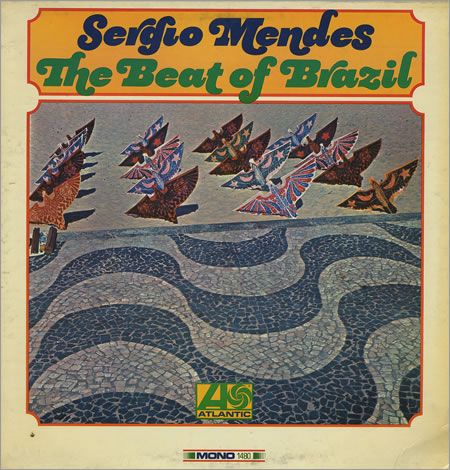
Mendes had relocated to New York by 1964, about the time Você Ainda Não Ouviu Nada! ("You Ain't Heard Nothin' Yet!") was released by Philips in his homeland. In North America the LP didn't appear until 1967, under the title The Beat of Brazil on Atlantic. The release came in the wake of the success of Mendes and Brazil '66.


The album wasn't a big seller in the U.S. and Canada at the time but there were numerous vinyl reissues under various titles in countries like The Netherlands and Japan. Here's a sample tune.

Ela é Carioca (She's a Carioca)


The album (under The Beat of Brazil title) is available on CD for literally pennies for a used copy in the Amazon Marketplace. The release is on the very reliable Collectables label, so you can buy with confidence.

As a download the album is being sold as both The Beat of Brazil and Você Ainda Não Ouviu Nada! by iTunes and others.

From YouTube comes Primitivo, another selection from the album.


Thursday, August 01, 2013

Laurens van Rooyen & Francis Goya - Concierto


I can't say that I'm usually much of a fan of the music of Dutch pianist Laurens Van Rooyen. Most of his albums, with the use of synthesizers and other electronic enhancements, seem to inhabit a nebulous area between old-fashioned easy listening and new age, without having much depth or character.

But Van Rooyen's 1987 album Concierto, a collection of pop versions of Latin classics, is enlivened by the presence of Belgian guitarist Francis Goya, who has also enhanced albums by similarly-styled pianists Richard Clayderman (France) and Richard Abel (Canada). Goya and Van Rooyen seem to bring out the best in each other as you can hear in the sample below, taken from a cassette version of the album.

La Comparsa


Concierto, which was issued on CD, vinyl and cassette, has long been out of print. It is, however, easily obtainable as a download.

Both Van Rooyen and Goya have an extensive collection of their back catalogues available as downloads. Only a few albums from each can be purchased on CD.

Here's Francis Goya performing Nostalgia, the tune that was a big hit for him in Europe in 1975 and launched his solo career. The video, uploaded to YouTube by the Francis Goya Foundation in 2012, appears to have been taken from a recent performance, although no date or venue is given.


“ The aim of the Francis Goya Foundation is to help young children and teenagers from “problem” regions and families worldwide by giving them access to art and music workshops and classes. ”

Monday, June 17, 2013

Tito Puente & His Orchestra - Bossa Nova by Puente


No one seemed to be immune when the bossa nova craze struck in the early 1960s, least of all the leading Latin bandleader of the day, Tito Puente (1923-2000).

Puente, who is said to have recorded more than 100 albums, gained wide fame in the early 1950s when the cha-cha and the mambo became extremely popular. In the 60s Puente expanded into big band jazz, Broadway tunes, pop music, and in the above case, bossa nova.

Bossa Nova by Puente came out in 1962 on Roulette. And of course it included a version of Antonio Carlos Jobim's Desafinado, which Stan Getz and Charlie Byrd had turned into a huge hit earlier in the year.

Desafinado


Bossa Nova by Puente was re-released on vinyl in 1988 and on CD several years later by the Spanish label Palladium. However, neither seems to be widely available.

The album is more easily obtained via download from eMusic and others. Quality is very good judging from the samples.

From YouTube here's another track from Bossa Nova by Puente.


Friday, May 03, 2013

Nilo Lopes and His Copacabana Orchestra - Product of Brazil-Bossa Nova


From 1943 until the late 1960s, the Seeco record label promised "The Finest in Latin American Music." The company, for the most part, lived up to that promise, with a roster that included Celia Cruz, Vicentico Valdez and Noro Morales.

Seeco also diversified into jazz and cabaret music, releasing recordings by Cy Coleman, Eartha Kitt and pianist Jose Melis, who served as music director for the Tonight Show when it was hosted by Jack Paar.

Product of Brazil - Bossa Nova came relatively late in the life of Seeco Records, coming out in 1963. The LP cover states "Recorded in Brazil" and there's no reason to doubt that claim. The company was known for the authenticity of its recordings, with representatives travelling throughout Latin America to record its artists.

Whether Nilo Lopes is a real person is another matter. There is no other reference to him in connection with Brazilian music other than this album. Nonetheless it's a pleasant listen overall, although the string section tends to be a bit strong in some places. There's a sample track below.

Creo Que Si


Many titles from the Seeco library have been available on CD and as downloads, although a lot of them appear to have come from dubious sources, i.e., someone's record collection. However, Product of Brazil - Bossa Nova has not so far made it into a digital format.

Sunday, February 17, 2013

Xavier Cugat - Say Si! Si!


Cuban-born bandleader Xavier Cugat (1900-1990) did more than anyone else to establish the popularity of Latin dance music, particularly the rumba, in the U.S. during the 1930s and 40s.

Cugat continued to be a popular live (particularly in Las Vegas) and recording artist long after the commercial peak of Latin dance music had passed. In the 1950s, he was recording for RCA Victor and from his catalogue for that company the budget label Pair put together a compilation called Say Si! Si! in 1994. This long out-of-print release was issued in all three formats -- vinyl, cassette and CD.

Among the recordings on Say Si! Si! was Granada, which first appeared on a 1959 RCA release, Cugat in Spain.


You can get Granada from the link below. The MP3 is taken from the cassette release of Say Si! Si!.

Granada

Say Si! Si! is available on CD for next to nothing (how does 10 or 11 cents sound?) in the Amazon Marketplace. Cugat's RCA recordings have been repackaged numerous times on CD and many of them are available as downloads. Check the usual sources.

Below is a rather odd Cugat novelty, Gesundheit, issued on an RCA Victor 45 in 1958 (Billy's Cha Cha was on the flip side).


Sunday, February 10, 2013

John Evans - Latin Brass


John Evans was a pseudonym for Belgian bandleader Francis Bay (1914-2005). You can read more about Bay at Space Age Pop Music.

Bay used the Evans name on several albums in the early 1960s for Directional Records, an imprint of Premier Albums, a company that was notorious for its poor quality budget label pressings. Although the LPs on Directional were a step above the usual quality of Premier product, they still fell far short of those being issued by such labels as London Phase4 and Command Records.

Premier aimed its Directional product at the same market as Phase4 and Command -- stereophiles looking for albums to show off their stereo systems. Premier even copied Command's style of art work and gatefold covers for the Directional albums.

The Directional label had a very short life span, even though Premier ran a full page ad in the Nov. 6, 1961 issue of Billboard espousing the imprint's supposed technical superiority.

Latin Brass was the first release on Directional Records. A sample track can be had below.

April in Portugal

To make matters worse, all of the tracks on Latin Brass had been released on earlier albums under the Francis Bay name on such labels as Omega and Phillips. Some reverb was apparently added for the Latin Brass release in a weak attempt to live up to the "Directional" sound claim.

Here's a further sampling of Bay's Latin sound, this time under his own name on the Phillips label.